Modular Spacecraft Design Paves Way for Next-Generation Observatories
Summary:
The world of space exploration is witnessing a significant breakthrough with the development of autonomous triangular modules that could potentially revolutionize the construction of mega-observatories. Researchers at Nanjing University of Aeronautics and Astronautics and the Bei...
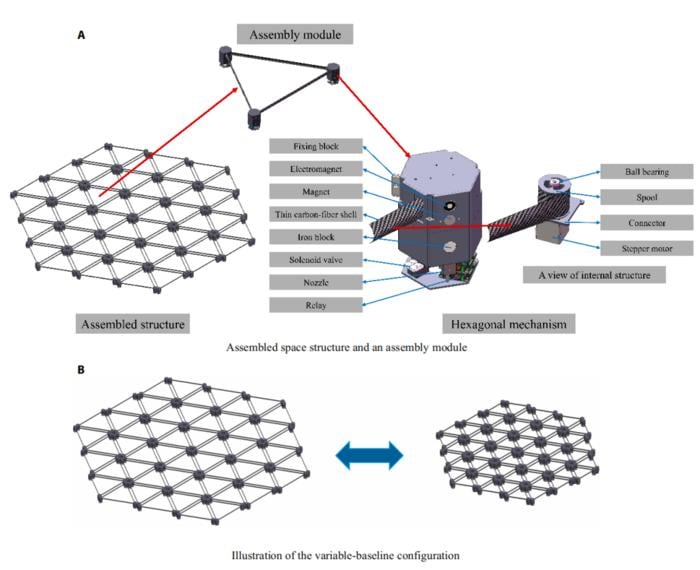
The world of space exploration is witnessing a significant breakthrough with the development of autonomous triangular modules that could potentially revolutionize the construction of mega-observatories. Researchers at Nanjing University of Aeronautics and Astronautics and the Beijing Institute of Technology have proposed a solution to the long-standing constraint on launching large objects into space. By designing self-shaping, deployable modules that can fine-tune their positioning and dimensions, scientists aim to overcome the limitations imposed by fairing size. The Human Dimension
The implications of this innovation are far-reaching and will have a profound impact on various aspects of human life. For astronomers, this technology means that future mega-observatories will be able to collect more data and make groundbreaking discoveries, shedding new light on the mysteries of the universe. The ability to build larger observatories will also enable scientists to study celestial phenomena in greater detail, leading to a better understanding of the cosmos and our place within it. Furthermore, this technology has the potential to enable more efficient communication networks in space, which could lead to improved connectivity for astronauts and spacecraft. What This Means Going Forward
As this technology continues to evolve, we can expect to see significant advancements in space exploration and astronomy. The development of autonomous triangular modules could pave the way for next-generation telescopes that will allow us to study distant galaxies and exoplanets in unprecedented detail. This, in turn, could lead to new discoveries about the origins of life in the universe and potentially even provide insights into the possibility of extraterrestrial life. For students and workers in the field of aerospace engineering, this innovation presents exciting opportunities for research and development, driving innovation and pushing the boundaries of what is possible in space exploration. As we look ahead, it is clear that this technology has far-reaching implications for humanity's understanding of the universe and our place within it. By harnessing the power of autonomous triangular modules, we may unlock new secrets about the cosmos and ultimately reveal new possibilities for human exploration and discovery.